Ignoring Temperature Control? That's Why Your 2.0g THC Vapes Lose Flavor So Fast
- Share
- Issue Time
- Jan 23,2026
Summary
This comprehensive guide examines why temperature management matters, explores the evolution from fixed voltage to multi-curve adaptive systems, and reveals how Transpring's technology solves the 2g THC vapes' flavor problem plaguing the industry.
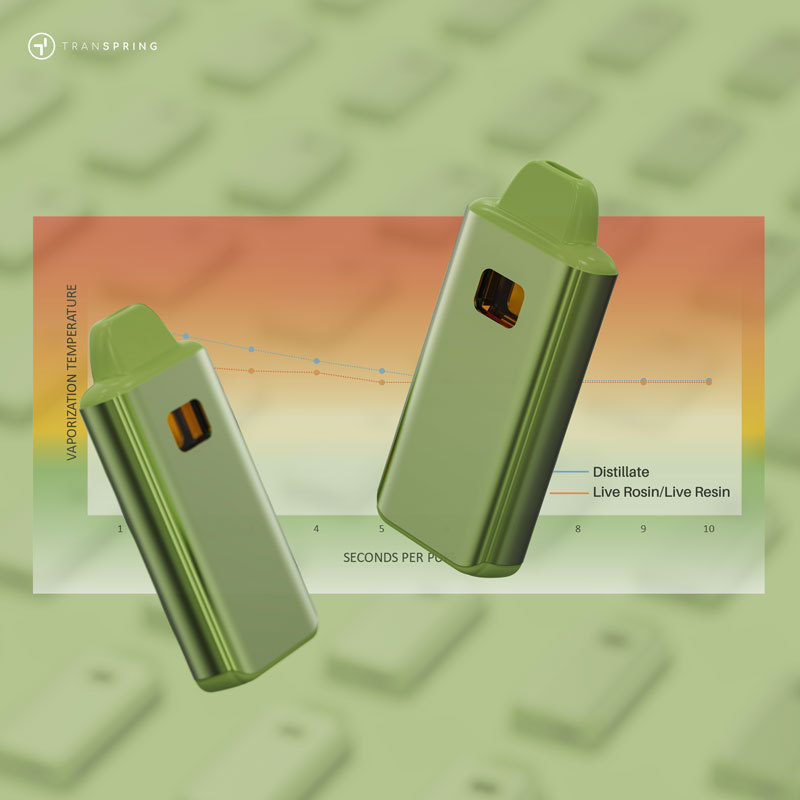
In recent years, consumers across forums and dispensaries increasingly complain that big-capacity vapes, such as 2.0g disposables and cartridges, start smooth, flavorful, and potent, but by the time half the cartridge is gone, flavor collapses, cough-inducing harshness starts, and the experience feels burnt or flat. The issue has become so widespread that some retailers are hesitant to stock larger format vapes, despite the higher profit margins they offer.
This isn't just a quality control problem; it's a fundamental design challenge that most manufacturers are failing to address. The culprit? One of the critical reasons is poor temperature control in large-capacity vape systems.
Why Temperature Control is Critical for 2.0g THC Vapes
When consumers talk about flavor, they’re really talking about terpene profiles, volatilization thresholds, thermal degradation, and sensory balance. In cannabis, terpenes are responsible for the smell and nuanced taste profiles—citrus, diesel, berry, pine, etc. These compounds vaporize at different temperatures. Unlike nicotine e-juice that uses PG/VG bases with relatively predictable vaporization points, THC distillates combined with complex terpenes require very precise thermal management to gently volatilize the desirable compounds without destroying them.
Temperature control becomes exponentially more important for 2.0g cartridges compared to smaller 0.5g formats. Here's why: users will take hundreds of additional puffs from a single 2.0g cartridge, and the physical dynamics of the system will change dramatically over that extended usage period if the temp control is poor.
For example, as cartridges are used repeatedly, some tiny substances in the cannabis oil may carbonize and accumulate on the ceramic core. With these carbonized deposits, the thermal properties of the ceramic core differ significantly from those of the original ceramic material. The carbonized surface requires a higher temperature to achieve the same vaporization effect; the original temperature will no longer allow the extract to vaporize optimally, and the flavor will not be fully released. Without sophisticated temperature management systems that can compensate for these changes, this problem is inevitable.
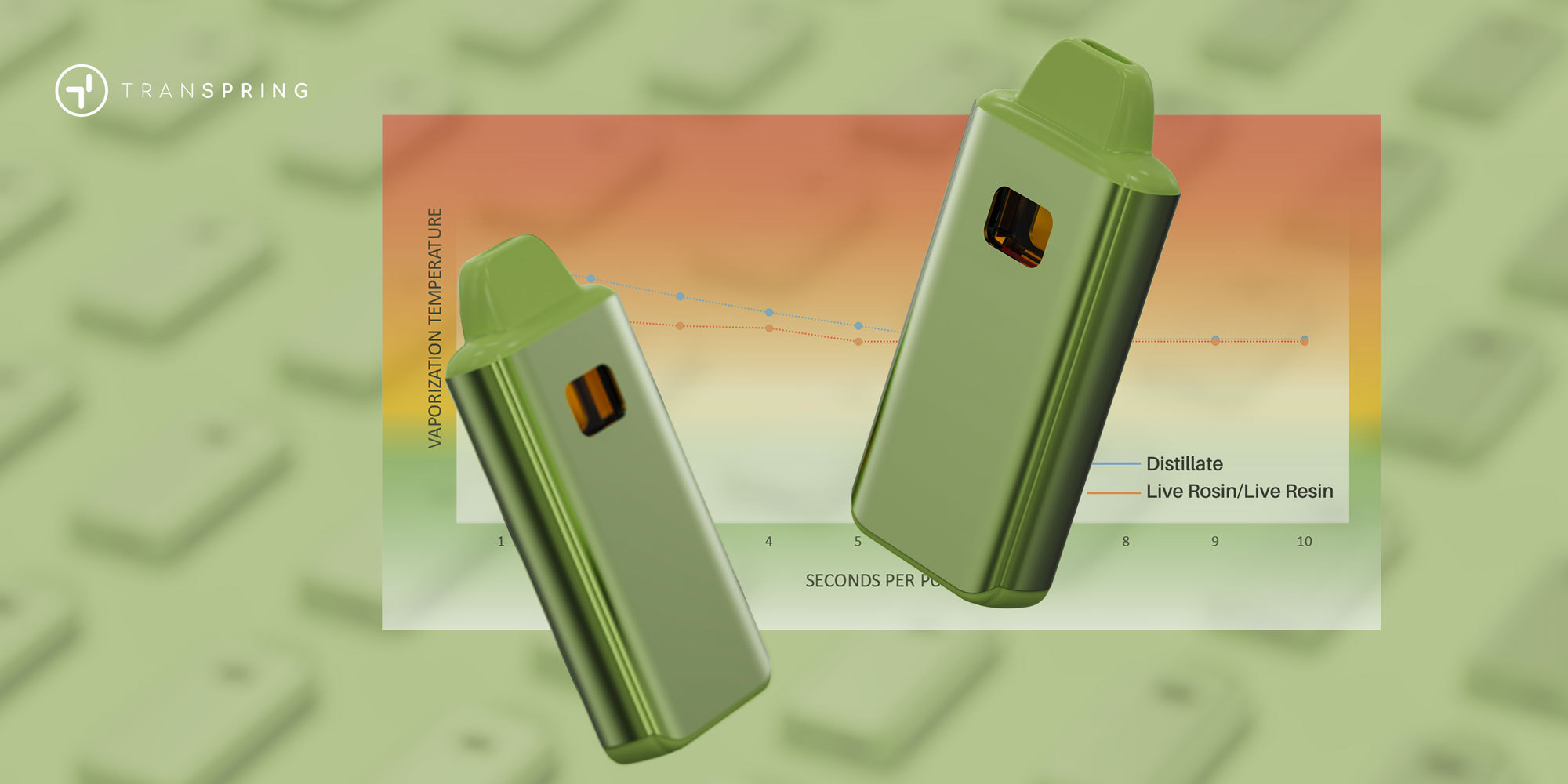
The Evolution of Temperature Control Technology
Understanding today's advanced temperature control requires tracing the technology's development through three distinct generations, each representing a quantum leap in sophistication.
Generation One: Fixed Voltage Systems
First-generation vape devices operated at a single predetermined voltage, typically 3.7V or 4.2V, depending on battery chemistry. These systems made no attempt to regulate temperature—they simply delivered constant power whenever activated.
Generation Two: Three-Tier Adjustable Voltage
The second generation introduced manual voltage selection, typically offering three preset power levels. Common configurations included:
Low: 2.6V for delicate oils and flavor preservation
Medium: 3.36V for balanced performance
High: 4.2V for maximum vapor production
This represented meaningful progress. Users gained the ability to customize their experience and could manually compensate for changing cartridge conditions.
Generation Three: Curve-Based Voltage Modulation
Current-generation temperature control employs curve-based voltage modulation, allowing dynamic power adjustment throughout each inhalation based on programmed voltage curves.
Rather than maintaining constant power delivery, these systems can ramp voltage up or down second-by-second during a puff.
Comparing Temperature Control Technologies
| Technology | How It Works | Pros | Cons |
| Fixed Voltage | Single power output | Zero learning curve for users | No adaptation; terpene burnout |
| Three-Tier Adjustable Voltage | Multiple fixed levels | User control | No dynamic response |
| Curve-Based Voltage | Time-segmented voltage within draw | Smoother draw; flavor focus | Learning cost for Brands |
Transpring's Multi-Curve Adaptive System: The 2.0g Solution
While standard curve-based modulation improves individual puffs, it fails to address the fundamental challenge of maintaining consistency across the hundreds of puffs consumed from a 2.0g cartridge.
Transpring's advanced temperature control system implements what we call NUTUN technology. Instead of programming a single voltage curve for the entire vape lifecycle, Transpring's system allows manufacturers to configure multiple distinct curves—typically 2-3 separate profiles—each optimized for different stages of vape use. The system offers two triggering mechanisms to determine when to transition between multiple curves.
1. Puff Count Triggering
The device maintains an internal counter of activation events. After predetermined thresholds, the system automatically advances to the next curve. (e.g., first 50 puffs vs. after 50 puffs)
2. Cumulative Time Triggering
Transitions occur after specific durations of coil activation. (e.g., first 200s vs. after 200s)
The result of this smart system is unprecedented performance consistency throughout the 2.0g vape's entire lifecycle. Users experience essentially identical vapor quality on puff 5 as they do on puff 250 because the temperature control strategy has intelligently evolved alongside the vape's physical state.
This directly addresses the core complaint that motivated this article: 2.0g THC vapes that deteriorate halfway through consumption. With Transpring's system, there is no "halfway disappointment." The 150th puff tastes as clean and flavorful as the first puff because the voltage curve has adapted to compensate for carbonization and thermal stress accumulation.
Consumer demand for 2.0g cartridges is undeniable—the value proposition of larger capacity resonates strongly with regular users. In today’s expanding cannabis vape market, brands that master temperature control, not just materials, are the ones that will truly lead in quality, performance, and consumer satisfaction.