How Much Does a Cannabis Vape Cost?
- Share
- Issue Time
- May 29,2026
Summary
Cannabis vape prices today reflect a rapidly evolving industry balancing affordability, technology, and extract quality. In Canada, average vape prices remain relatively stable around the mid-CAD $30 range, while U.S. markets show much wider pricing variation, from ultra-competitive value markets to premium limited-license states.

The US market: wide price bands by state
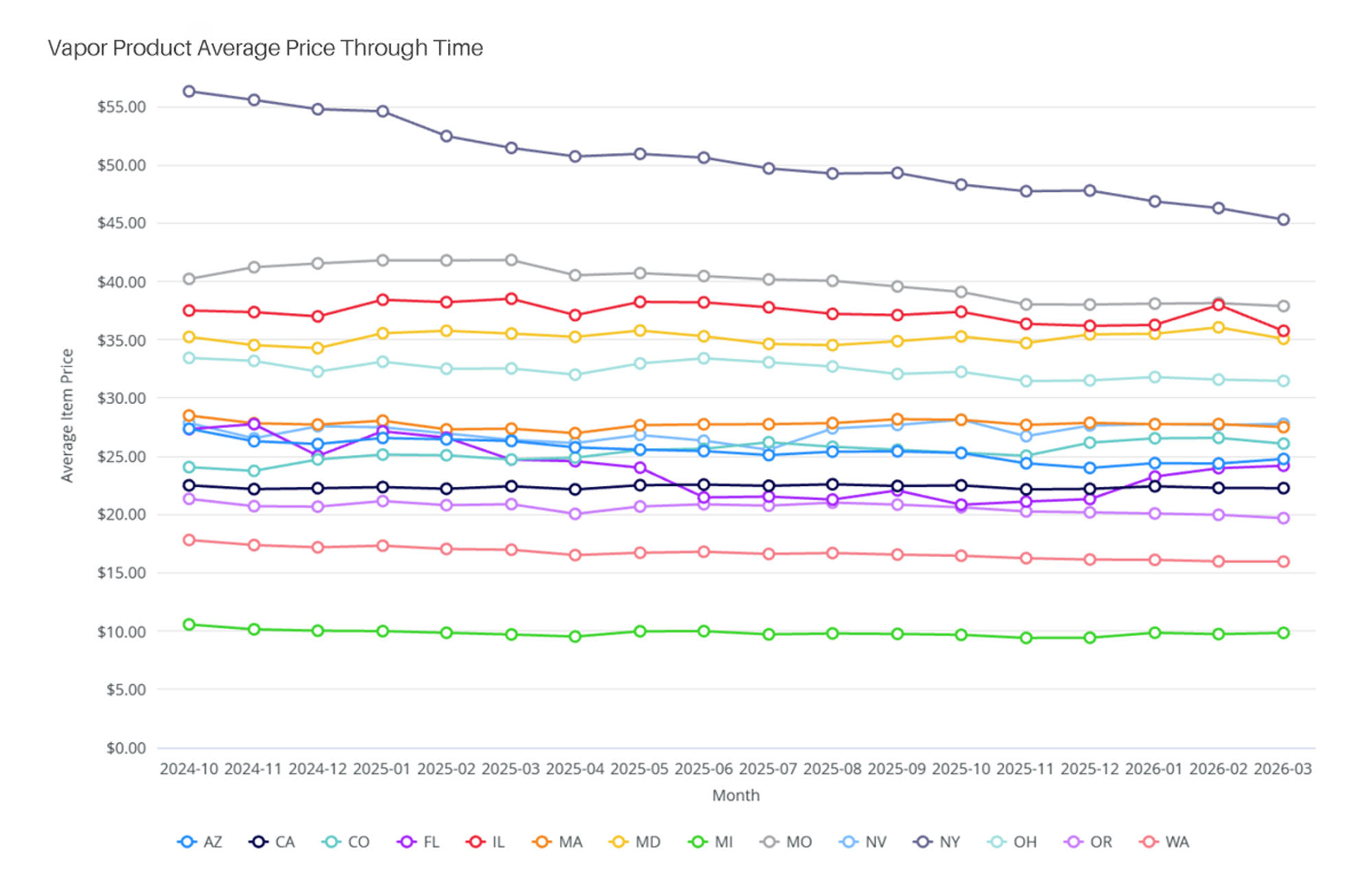
Average item prices for cannabis vape products across 15 US states tracked between October 2024 and March 2026 reveal a striking spread. New York (NY) sits at the top of the market, with average prices that started around $56 in late 2024 and gradually declined to approximately $45 by March 2026, yet it remains the highest of any state in the dataset. At the other end of the spectrum, Michigan (MI) consistently priced vapes at roughly $10, making it one of the most competitively priced legal markets in the country.

What drives the price of a cannabis vape?
The gap between a $10 Michigan cart and a $56 New York vape pen doesn't happen by accident. Several interconnected factors shape what you pay at the counter.
1. Regulatory environment and taxation
States with high excise taxes, complex licensing requirements, or limited license caps naturally push retail prices upward. New York's relatively recent and tightly controlled rollout contributed to its elevated price tier. Michigan, by contrast, has a large number of licensed retailers and a highly competitive market, which has compressed margins significantly.
2. Market maturity and competition
Older, more saturated markets tend to see lower prices over time as brands compete for shelf space. The downward pricing trend visible across most US states in the 2024–2026 data reflects this dynamic. When many brands offer similar products, price becomes a key competitive lever.
3. Product segment and format
Disposable vapes, 510-thread cartridges, and pod systems occupy very different price points. Live resin or live rosin extracts command a premium over distillate-based products. Package size also matters; a 0.5g cart costs proportionally more per gram than a 1g equivalent.
4. Brand positioning
Premium brands with strong consumer trust, celebrity backing, or innovative hardware can sustain higher prices regardless of the market. Value-tier and house brands, often sold exclusively through a single retail chain, apply downward pressure on the category average.
5. Supply chain and cost of production
Cannabis remains federally illegal in the US, preventing interstate commerce and forcing each state to maintain its own production infrastructure. This significantly inflates costs compared to industries where goods can be manufactured at scale and shipped nationally. Canada's federal legalization allows more efficient national supply chains, which partly explains the relatively stable pricing across provinces.
The bottom line
Across the US and Canada, the "typical" cannabis vape price is really a spectrum. Shoppers in regulated markets can expect to pay anywhere from roughly $10 to $56, depending on their state, the product type, and the brand. The overall trajectory, both in the US and Canada, points toward gradual price compression as markets mature and competition intensifies. For consumers, that's generally good news. For producers and retailers, it means that brand differentiation and product quality are increasingly the only sustainable means of justifying a premium.